Tag: data science

ML4MatSci: Hands-on Machine Learning for Research in Materials Sciences – 2nd PhD Summer School

📍 Sarajevo, Bosnia and Herzegovina
📅 10-12 June 2026

The ML4MatSci PhD School aims to equip current and prospective PhD students with a solid foundation in machine learning (ML) methods, demonstrated through real-world research led by scientists actively applying ML in their own work.

Our goal is to empower and inspire PhD students to confidently integrate ML into their research, fostering creativity, critical thinking, and innovation in applying data-driven approaches to materials science and related fields.


🔍 Why attend

The ML4MatSci PhD School offers a unique opportunity to:

  • Discover how cutting-edge AI is transforming materials science research
  • Gain hands-on experience with modern tools for modeling, simulation, and characterization
  • Present your research and receive expert feedback
  • Network with leading researchers and peers
  • Join a growing interdisciplinary community at the intersection of AI and materials science

👥 Target Audience

  • PhD students and postdoctoral researchers in Materials science, Physics, Chemistry, Computer science
  • Aspiring PhD students interested in AI-driven research

📚 Prerequisites

  • Basic programming knowledge (Python preferred)
  • Fundamentals of ML and AI
  • Understanding of datasets and evaluation metrics
  • Enrollment in (or preparation for) a PhD program in a relevant field

🔬 Scientific Focus Areas

  • Generative AI for Materials Science
  • Agentic AI & Multi-Agent Systems
  • Digital Twins of Materials and Processes
  • Large Language Models (LLMs)
  • Graph Neural Networks & Physics-informed Neural Networks
  • Foundation models for materials science
  • Explainable AI (XAI) and multi-modal learning
  • Tools & Languages: Python, PyTorch, TensorFlow, JAX, Scikit-learn

🧪 Teaching Format

The school runs over three intensive days, combining theory and practice:

  • 📚 Lectures – Advanced AI topics delivered by leading experts
  • 💻 Hands-on Sessions – Practical workshops on ML tools and methods
  • 🏭 Industrial Session – Real-world ML applications in industry
  • 🎤 Poster Session – Present and discuss your research
  • Elevator Pitches – Short, impactful research presentations

📝 Application Details

📄 Required Documents

Applicants must submit:

  • Short CV (1 page)
  • Motivation letter (½ page)
  • Poster title and abstract (¼ page)
  • Travel cost estimate (in Eur)
  • Statement on participation without EU funding

💶 Financial Support

The EuMINe COST Action is pleased to offer reimbursement for up to 20 participants, covering travel expenses and daily allowances. Participants will be selected based on:

  • Interest in the school by submitting the CV, a motivation letter and a poster abstract 
  • Gender and age balance
  • Geographic inclusivity, with preference for Inclusiveness Target Countries (ITCs) and Near Neighbour Countries (NNCs)

📅 Important Dates


👩‍🏫 Lecturers

  • Jacob Goldberger – Bar-Ilan University (Israel)
  • Keith Butler – University College London (UK)
  • Salim Belouettar – Luxembourg Institute of Science and Technology (Luxembourg)
  • Patrícia Ramos – Polytechnic of Porto / INESC TEC (Portugal)
  • Michael Moeckel – Technische Hochschule Aschaffenburg (Germany)
  • Amila Akagic – University of Sarajevo (Bosnia and Herzegovina)
  • Amra Hasecic – University of Sarajevo (Bosnia and Herzegovina)

📌 Programme

The complete programme will be available soon.


🧑‍💼 Organizers

  • Michael Moeckel – Technische Hochschule Aschaffenburg (Germany)
  • Amila Akagic – University of Sarajevo (Bosnia and Herzegovina)
  • Amra Hasecic – University of Sarajevo (Bosnia and Herzegovina)
  • Francesco Mercuri – National Research Council (Italy)

📍 Practical Information

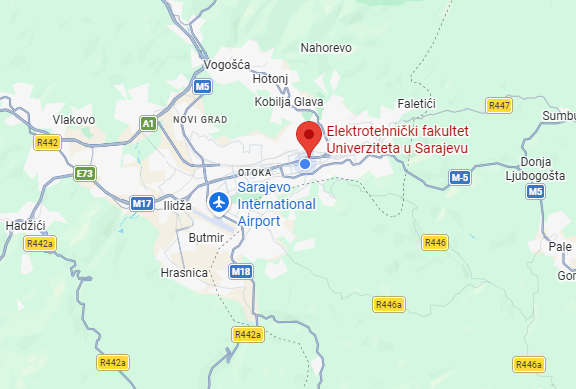
Location: Sarajevo, Bosnia and Herzegovina

Venue

Faculty of Electrical Engineering
University of Sarajevo
Kampus Univerziteta
71000 Sarajevo

📧 Contact:
Amila Akagic — aakagic@etf.unsa.ba

AI & Material Science – 24-26 September 2025 (Ljubljana, Slovenia)

We are pleased to invite you to submit an abstract to the AI for Materials track, taking place in Ljubljana from September 24 to 26, 2025. The event is co-organized by the “European Materials Informatics Network” and the “Data-driven Applications towards the Engineering of functional Materials: an Open Network”, under the auspices of the European Cooperation in Science and Technology funding organisation.

Our event aims to bring together scientists, innovators, start-ups, and industry leaders to explore the state of the art and latest breakthroughs in artificial intelligence for materials discovery. Discussions will focus on identifying current limitations, overcoming bottlenecks, and fostering an open, synergic ecosystem for AI-driven materials research in Europe – where academia, large enterprises, start-ups, and scale-ups thrive together.

The EUMINE COST Action CA22143 and DAEMON COST Action CA22154 act as a co-organizer of the event. COST (European Cooperation in Science and Technology) is a funding agency for research and innovation networks. Our Actions help connect research initiatives across Europe and enable scientists to grow their ideas by sharing them with their peers. This boosts their research, career and innovation.


📝 Important dates

  • 15. 7. 2025 – Paper/abstract submission deadline
  • 21. 7. 2025 – Notification of acceptance
  • 25. 7. 2025 – Camera-ready version and Author registration deadline

👉 Submission link


Conference Topics:

  • Materials discovery: automated computational and experimental workflows
  • Materials modeling: fast and accurate simulations
  • Retrosynthesis discovery: LLMs and agentic-AI
  • Process-Structure-Property relationship discovery
  • Materials informatics: from material discovery to market

Submission Guidelines
Abstracts must be submitted using the Springer LNCS template. Both LaTeX and Word versions are available.
Abstracts will be included in the conference proceedings
Length: 1–2 pages (including references), formatted in LNCS style.
All submissions should include: Title, Authors, Affiliations, Keywords, Main text, and References.
Title: Concise and informative.
Authors and Affiliations: Full names and institutional affiliations.
Keywords: 3–5 relevant terms (e.g., deep learning, materials discovery)

Main Text:

  • Intro/Motivation: Brief context on the materials challenge.
  • Method: Brief description of the AI technique(s) adopted.
  • Results: Key findings or objectives, ideall with one figureConclusion/Future Work: Final remarks or outlook.

Program Chairs

  • Francesco Mercuri (CNR Bologna)
  • Kevin Rossi (TU Delft)

For more information visit the conference website